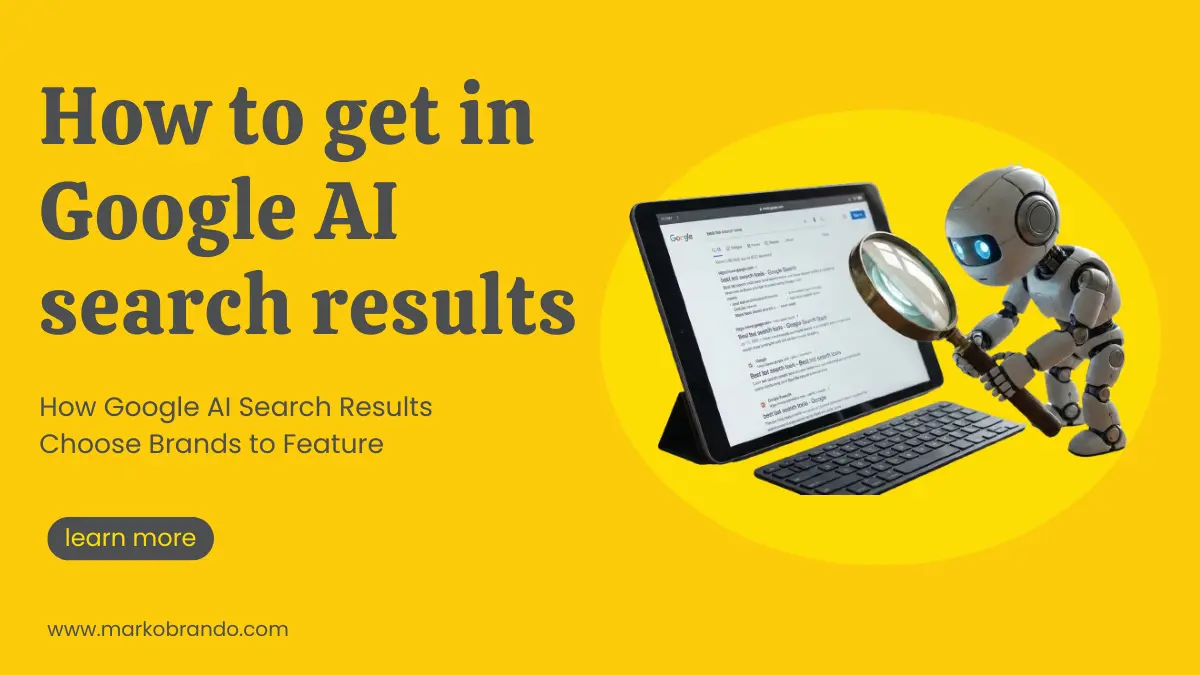
How Google’s AI Chooses Which Brands to Cite in Search Results
Summarize with AI


Google Search is no longer just ranking blue links, it is selecting brands to quote, summarize, and recommend through AI-generated results. With the expansion of Google AI Overviews, large language models (LLMs) are actively deciding which brands are trustworthy enough to cite.
For businesses wondering how to rank in Google or how to get first rank in Google search, the real question in 2026 is:
How does Google’s AI decide which brands deserve visibility?
This article breaks down how Google’s AI evaluates content, brands, and authority—plus how you can optimize your site to earn citations in AI-driven search results.
Understanding Google AI Search Results in 2026
Google’s modern search ecosystem is powered by multiple AI systems, including:
LLMs (Large Language Models) for summarization and contextual answers
Knowledge Graph for entity validation
Helpful Content & SpamBrain systems for quality filtering
EEAT-based evaluation layers for trust and credibility
Instead of ranking pages alone, Google AI now evaluates brand-level signals.
Key Shift:
Search visibility is moving from page authority → brand authority
This is why many websites see traffic volatility even with “perfect” on-page SEO.
How LLMs Decide Which Brands to Cite
Google’s AI does not randomly pick sources. It uses probabilistic and entity-based reasoning to identify reliable brands.
Core Evaluation Signals Used by LLMs
1. Entity Recognition
Is your brand recognized as a real, independent entity?
Does Google understand who you are and what you do?
2. Topical Authority
Are you consistently publishing content within a focused niche?
Or are you scattered across unrelated topics?
3. Consensus Signals
Do multiple credible sources mention or reference your brand?
AI favours brands that appear repeatedly across the web ecosystem.
4. Content Utility
Does your content clearly answer user intent?
Is it written for humans—not search engines?
According to AI search trend analysis heading into 2026, brands with strong topical depth are cited nearly 3× more often in Google AI Overview citations than generic content sites.
Google Ranking Factors That Matter More in the AI Era
Traditional ranking signals still exist - but their weight has shifted.
High-Impact Google Ranking Factors (2026)
Brand-level EEAT signals
Author expertise & real-world credentials
Content freshness + historical consistency
External brand mentions (not just backlinks)
Structured data reinforcing entity identity
If you’re trying to understand how to get ranked in Google search, optimizing for brand trust is now non-negotiable.
EEAT Breakdown for AI Visibility in 2026
Google’s AI models are increasingly trained to reward experience-backed, original insights rather than recycled or generic content. As AI-driven search evolves, EEAT (Experience, Expertise, Authoritativeness, Trustworthiness) has become a core evaluation framework that determines whether a brand appears in Google AI search results and AI Overview citations.
Below is how each EEAT pillar works—and how Google’s AI interprets them.
Experience: Demonstrating First-Hand Knowledge
Experience signals tell Google’s AI that content is created by someone who has actually done the work, not just studied it theoretically.
AI systems look for:
First-hand insights drawn from real campaigns, projects, or implementations
Case studies that showcase measurable outcomes and learning
Practical examples based on real execution rather than abstract explanations
In 2026, Google AI favours content that reflects lived experience—such as lessons learned, mistakes avoided, and real-world applications. Pages that clearly demonstrate “we’ve been there, we’ve done this” are far more likely to be selected in AI-generated answers.
Expertise: Validating Knowledge and Skill
Expertise focuses on whether the content creator is genuinely qualified to speak on the topic.
Google AI evaluates:
Detailed author bio with relevant professional experience
Educational background, certifications, or industry roles
Consistent publication of high-quality content within a specific domain
LLMs are trained to recognize patterns of subject-matter mastery over time. Content written by identifiable experts rather than anonymous or generic authors—signals higher reliability and depth, increasing its chances of ranking and citation in Google AI search results.
Authoritativeness: Establishing Industry Recognition
Authoritativeness measures how widely your brand or voice is recognized across the digital ecosystem.
Key author signals include:
Mentions from trusted publications and reputable websites
References across niche platforms, communities, and industry forums
Consistent association with a specific topic or industry
Google’s AI models cross-check information against multiple trusted sources. When your brand repeatedly appears in authoritative contexts, AI systems treat it as a consensus-backed source, making it more likely to be cited in AI Overviews and advanced search responses.
Trustworthiness: Building Confidence and Reliability
Trustworthiness is the foundation of EEAT and often the deciding factor for AI visibility.
Google AI assesses trust through:
Transparent business information, including contact details and ownership
Authentic user reviews and social proof
Secure website infrastructure (HTTPS, data protection standards)
Consistent branding across web, social, and third-party platforms
In an AI-driven search environment where misinformation risk is high, Google prioritizes sources that demonstrate stability, transparency, and credibility. Even highly informative content may be excluded from AI results if trust signals are weak or inconsistent.
Why EEAT Matters More Than Keyword Density
Pages aligned with EEAT principles are significantly more likely to appear in Google AI search results, even when traditional keyword density is low. This reflects Google’s shift from keyword-centric ranking toward trust- and authority-based content evaluation.
In short: Strong EEAT tells Google’s AI who to trust, not just what to rank.
What’s the Difference Between Earning AI Citations and Traditional Link Building?
While traditional link building has long been a core SEO tactic, earning AI citations represents a fundamental shift in how visibility is achieved in Google’s AI-driven search ecosystem. The two approaches differ not just in execution - but in intent, evaluation, and long-term impact.
Traditional Link Building: Page-Level Validation
Traditional link building focuses on acquiring backlinks from external websites to improve a page’s authority. Google historically used these links as signals of popularity and relevance. The emphasis was often on:
Quantity and quality of backlinks
Anchor text optimization
Domain authority of linking sites
Although links still matter, this method primarily validates pages, not brands. In the AI era, backlinks alone are no longer sufficient to guarantee visibility, especially in Google AI search results.
AI Citations: Brand-Level Trust and Authority
AI citations work differently. Google’s AI models cite brands and sources they trust, not simply pages with strong backlink profiles. These citations are generated when AI systems:
Recognize your brand as a credible entity
Confirm topical authority across multiple signals
Validate content accuracy against trusted sources
Instead of asking “Who links to this page?”, AI asks “Which brand consistently provides reliable, experience-backed answers?”
Also Read: AI-Driven Personalization: Case Studies on How Brands Use AI to Tailor Customer Journeys in 2026
Why Google AI Citations Matter More in 2026
Google AI Overviews are designed to minimize misinformation and maximize user trust. As a result, AI systems prefer citing:
Expert-led, original content
Brands with strong EEAT signals
Sources with consistent industry recognition
This makes AI citations harder to manipulate but far more valuable. Unlike traditional links, AI citations reinforce brand credibility across the entire search ecosystem, not just rankings for a single keyword.
Winning Visibility in the Age of AI Search
As Google’s AI-driven search continues to reshape how buyers discover and evaluate brands, visibility is no longer just about rankings - it’s about being selected, cited, and trusted by AI systems. Brands today face a clear choice: continue relying solely on traditional SEO tactics, or evolve their strategy to understand how AI models determine which sources deserve attention.
AI citations are fast becoming a critical competitive signal. They reveal which brands are influencing AI-generated answers, shaping buyer perception, and earning trust at scale. Without insight into these citation dynamics, even well-optimized websites risk losing relevance as AI Overviews and generative search experiences take center stage.
How Marko & Brando Helps Brands Earn AI Citations
At Marko & Brando, we help brands move beyond outdated SEO playbooks and build AI-visible authority that Google’s models recognize and reward.
What We Do Differently
AI-first SEO & GEO strategies designed for Google AI search results
Brand-level EEAT frameworks that increase trust, citations, and long-term visibility
Topical authority engineering that positions brands as category leaders
- Entity-based optimization that helps Google’s AI understand, validate, and reference your brand
We don’t just track rankings—we analyze how and where your brand appears in AI-generated responses, identify competitive gaps, and design strategies that improve citation frequency across AI-driven discovery platforms.
Built for the Future of Search
Marko & Brando works with growth-focused brands across industries including:
B2B & SaaS
Technology, Education, and Professional Services
As a trusted digital marketing agency in Kolkata, our team blends technical SEO, content intelligence, and AI search expertise to help brands stay visible as Google’s algorithms evolve.
Final Takeaway
The future of search belongs to brands that earn trust, demonstrate expertise, and deliver real value not those chasing short-term SEO hacks. AI citations are not accidental; they are the outcome of strategic authority-building done right.
If you want your brand to be discovered, cited, and chosen in Google’s AI-powered search landscape, Marko & Brando is your strategic partner for AI-first visibility.
FAQs:
1. How to get first rank in Google search?
Focus on topical authority, expert-led content, strong EEAT signals, and a great user experience. Google now rewards trust and relevance over keyword-heavy tactics.
2. How do I rank the 1st page on Google?
Align content with search intent, optimize technical SEO, and build consistent brand credibility through high-quality content and trusted mentions.
3. How to rank in Google AI search?
Create experience-backed content, strengthen brand entity signals, and earn trust across authoritative platforms so Google’s AI recognizes your brand as a reliable source.
4. How to get 4.9 on Google reviews?
Deliver excellent service, ask satisfied customers for reviews, respond to feedback professionally, and maintain transparency to build long-term trust.

Article by
Marko & Brando
For businesses looking for impactful digital marketing services, Marko & Brando is the name to trust. Our data-driven strategies ensure maximum ROI, helping your brand reach new heights. Experience the power of digital transformation with our expertise.
Real Estate Lead Generation Guide: Tools, Tactics & Examples

Marko & Brando
September 24, 2026
Best Financial Services Advertising Strategy for Banks
Marko & Brando
September 20, 2026

What Is a Content Calendar? Examples and a Step-by-Step Guide
Marko & Brando
September 15, 2026

We Audited 30 Shopify Stores: Here's the Number One Conversion Killer
Marko & Brando
September 10, 2026