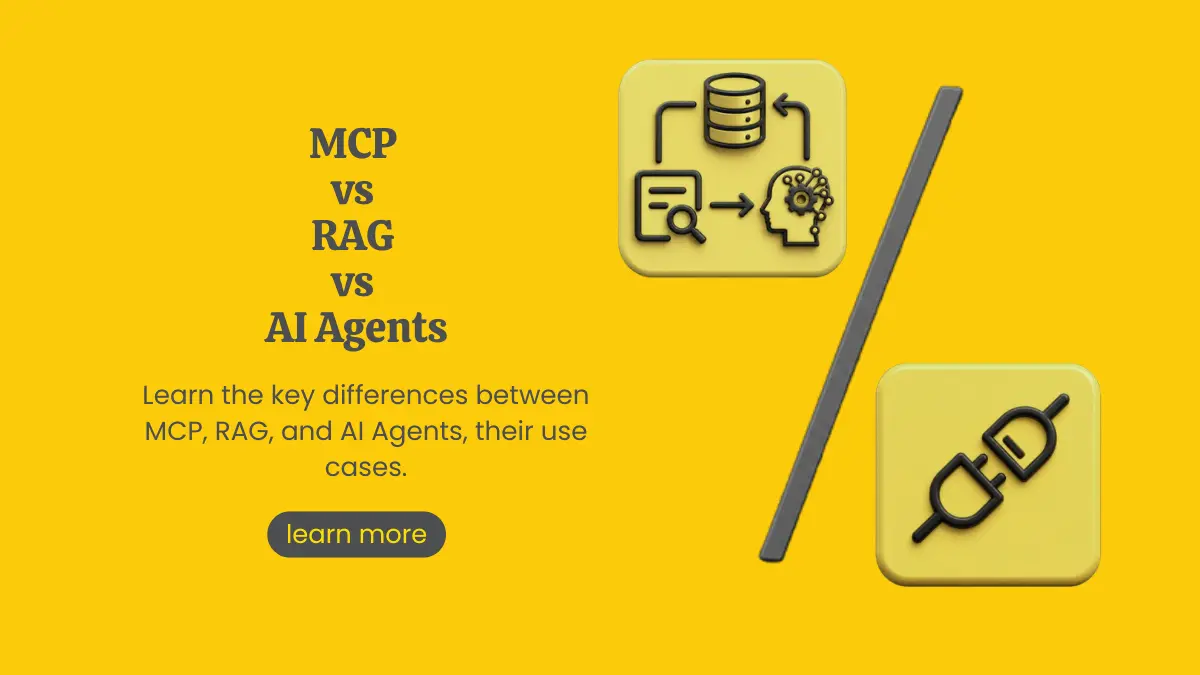
MCP vs RAG vs AI Agents: Key Differences, Use Cases & When to Use Each
Summarize with AI


If you've spent any time around AI product teams this year, you've probably heard all three of these terms tossed around in the same breath, sometimes even in the same sentence, as if they're competing options on a menu. They're not. MCP, RAG, and AI agents solve different problems, and mixing them up is the fastest way to build a system that's expensive, slow, or just plain wrong for what you actually need.
This guide breaks down what each one really does, where they overlap, where they don't, and how to decide which one (or which combination) fits your project.
The Short Version
Before we get into the weeds, here's the one-paragraph answer:
RAG (Retrieval-Augmented Generation) is a technique for giving a language model access to external knowledge at the moment it answers a question; think of it as an open-book exam.
MCP (Model Context Protocol) is a standardized way for AI models to connect to tools, databases, and services; think of it as the universal plug that lets an AI actually use things, not just read about them.
AI agents are systems that plan, decide, and take multi-step action toward a goal, often using RAG and MCP as building blocks along the way.
In other words, RAG answers "what does the model know right now," MCP answers "what can the model connect to," and agents answer "what can the model actually do, over multiple steps, without a human steering every move."
What Is RAG, Really?
RAG exists because language models have a knowledge problem. A model is trained on a fixed snapshot of data, and after that snapshot is taken, the world keeps moving; new products launch, prices change, policies get updated, and none of that is baked into the model's weights. Ask it something recent or something specific to your company, and it will either say it doesn't know or, worse, confidently make something up.
RAG fixes this by pulling relevant documents from a knowledge base a vector database, a set of PDFs, a wiki, whatever and feeding that content into the model's context window right before it generates a response. The model isn't relying on memory anymore; it's reading source material in real time and answering based on that.
Where RAG shines:
Customer support bots that need to answer from an ever-changing help center
Internal tools that search through company documents, contracts, or policies
Any chatbot where accuracy and citations matter more than creativity
Where RAG falls short: it's fundamentally a retrieve-and-respond loop. It doesn't take action, it doesn't remember across sessions unless you build that separately, and it doesn't decide to do a series of things on its own. It's a smarter lookup, not a smarter worker.
What Is MCP, Really?
MCP is newer, and it solves a completely different bottleneck: connectivity. Before MCP, if you wanted an AI model to check your calendar, query a database, or send a Slack message, you had to write custom integration code for every single tool, for every single model. Multiply that across a dozen tools and three different AI providers, and you've built a maintenance nightmare.
MCP standardizes that connection. It works a bit like USB-C for AI — instead of a different cable for every device, you get one protocol that any compliant model can speak, and any compliant tool can expose itself through. A company builds an MCP server once for its product (say, a project management tool), and any MCP-compatible AI can now read and act on that data without custom glue code.
Where MCP shines:
Connecting an AI assistant to real business tools — CRMs, ticketing systems, file storage, internal APIs
Letting one model work across many services without a rebuild for each one
Standardizing how permissions and actions are exposed to AI systems, which also helps with security and auditing
Where MCP falls short: MCP itself doesn't generate answers, retrieve knowledge, or plan multi-step work. It's plumbing. Extremely useful plumbing, but plumbing all the same; it needs something on the other end deciding what to do with the connection.
What Are AI Agents, Really?
An AI agent is the layer that actually uses judgment. Instead of answering one question and stopping, an agent breaks a goal down into steps, decides what information or tools it needs at each step, executes those steps, checks the results, and adjusts if something doesn't go as planned. A basic chatbot answers; an agent works.
A practical example: ask a chatbot "what's the status of my order?" and it looks up one record and replies. Ask an agent to "reschedule my order if it's delayed by more than three days and notify the warehouse," and it has to check the order status, evaluate a condition, decide whether action is needed, take that action, and confirm it happened — all without a human walking it through each step.
This is where RAG and MCP usually show up inside an agent rather than as competitors to it. An agent might use RAG to pull relevant policy documents before deciding on a refund, and use MCP to actually connect to the order system and process that refund. The agent is the decision-maker; RAG and MCP are two of the tools in its kit.
Where agents shine:
Multi-step workflows: research tasks, scheduling, order processing, IT ticket triage
Situations where the "right next step" depends on what happened in the previous step
Reducing manual, repetitive coordination work across tools
Where agents fall short: they're harder to build reliably, harder to test, and a lot easier to get wrong. An agent that mis-plans a step can compound that error across the whole task, so they need more guardrails, monitoring, and clearly scoped permissions than a simple RAG chatbot does.
Side-by-Side Comparison
So Which One Do You Actually Need?
Here's a simple way to think about it:
If your problem is "our answers are outdated or don't reflect our own data," you need RAG.
If your problem is "our AI can't reach the tools and systems it needs to," you need MCP.
If your problem is "we need this handled end-to-end without a person manually driving every step," you need an agent and that agent will probably lean on RAG for knowledge and MCP for connectivity anyway.
Most serious AI systems being built in 2026 don't pick one of these in isolation they layer them. A support agent might use MCP to pull a customer's order history, RAG to check the current return policy, and agentic planning to decide whether to approve a refund automatically or escalate it to a human. Understanding each piece separately is what lets you debug the system when something goes wrong, instead of treating the whole thing as one confusing black box.
Getting the Architecture Right Matters More Than the Hype
It's easy to get caught up in which term is trending this month. The businesses actually getting value out of AI right now are the ones that picked the right architecture for their actual problem not the flashiest one. A well-built RAG system that answers customer questions accurately will outperform a poorly-scoped "agent" that takes confident wrong actions, every time.
If you're trying to figure out where AI genuinely fits into your marketing stack, your customer support, or your internal operations — and where it's just noise that's exactly the kind of strategic groundwork a good Digital Marketing Agency in Kolkata like Marko & Brando can help you map out, before you spend a rupee on the wrong build.
Frequently Asked Questions
Is MCP a replacement for RAG?
No. They solve different problems. MCP handles connectivity; RAG handles knowledge retrieval. You can use either alone or both together.
Do I need an AI agent for my chatbot?
Not necessarily. If your use case is answering questions from a knowledge base, a well-built RAG system is simpler, cheaper, and easier to control than a full agent.
Which one is hardest to build?
Agents, generally, because they require planning logic, error handling, and safeguards on top of whatever RAG and MCP components they use.
Can I use MCP and RAG together?
Yes — this is increasingly the standard pattern. An agent uses MCP to connect to live tools and RAG to pull in relevant documents, then reasons over both to decide what to do next.
.webp)
Article by
Deep Mondal
I help businesses turn organic search into a consistent source of qualified leads and revenue, not just traffic. With years of hands-on SEO experience, I specialize in combining AI-driven SEO, technical optimization, and search intent strategy to help brands grow across both traditional search and emerging AI platforms.


Durga Puja Marketing Guide: How Brands Can Win the Pujo Season in Kolkata

Deep Mondal
October 09, 2026

Real Estate Lead Generation Guide: Tools, Tactics & Examples
Marko & Brando
September 24, 2026
Best Financial Services Advertising Strategy for Banks
Marko & Brando
September 20, 2026
What Is a Content Calendar? Examples and a Step-by-Step Guide
Marko & Brando
September 15, 2026