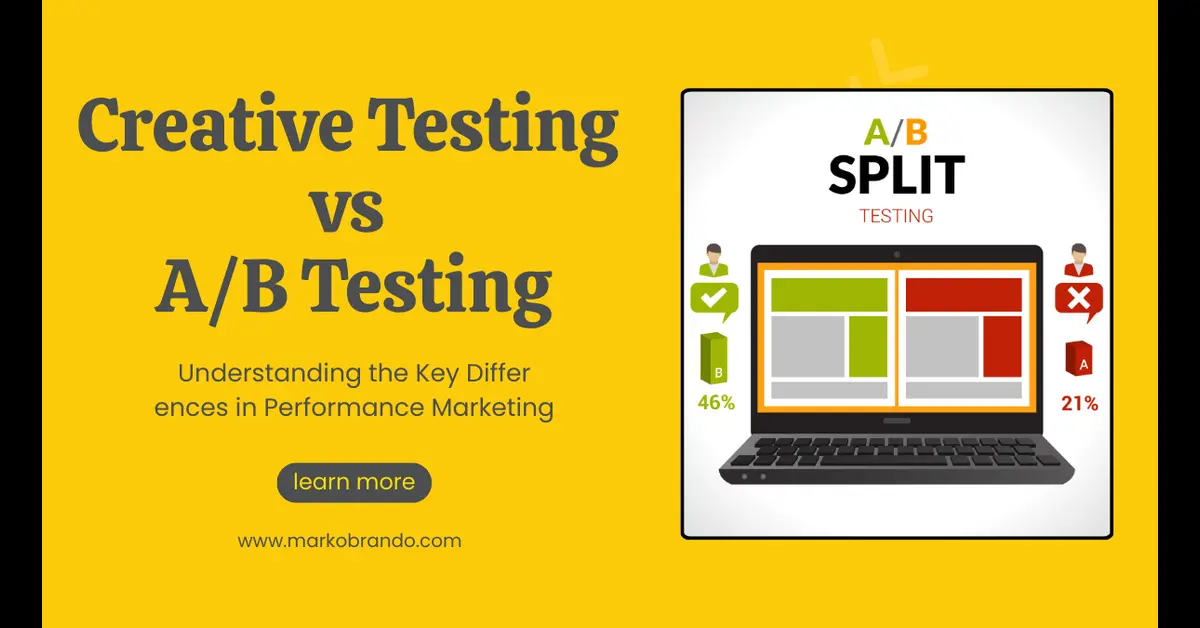
Creative Testing vs A/B Testing: Understanding the Key Differences in Performance Marketing
Summarize with AI


In the world of performance marketing, every campaign decision must be backed by data. Brands today are constantly competing for attention across platforms like social media, search engines, and display networks. Without proper testing, even the most well-designed ad campaign can fail to deliver results.
This is where structured ad testing methods become essential. Two of the most commonly used techniques are ad creative testing and A/B testing. While both aim to improve campaign performance, they serve different strategic purposes.
For marketers running paid campaigns especially on platforms like Facebook, Instagram, and Google understanding the difference between ad creative testing and A/B testing can significantly improve ROI, reduce wasted ad spend, and uncover high-performing ad concepts.
In this blog, we explore the key differences between these two testing approaches, how they work within performance marketing, and when businesses should use each method.
What is Ad Creative Testing?
Ad creative testing is the process of experimenting with multiple creative elements in an advertisement to determine which concept resonates most with the target audience. The goal is to discover which creative idea, visual, message, or storytelling approach drives the best engagement and conversions.
Elements Typically Tested in Ad Creative Testing
Creative testing can involve experimenting with several ad components:
Visual style (images, illustrations, or videos)
Messaging and value propositions
Emotional vs rational storytelling
Call-to-action phrasing
Ad format (carousel, video, static image)
Design elements and color schemes
Platforms like Facebook and Instagram have made Facebook ads creative testing particularly important because audience engagement often depends on the quality and relevance of the ad creative.
Example: E-commerce Brand Creative Testing
An online fashion retailer launches three ad concepts:
After running an ads test, the brand finds that the sustainability-focused creative generates 40% higher engagement and 25% lower cost per conversion. This insight helps the brand reposition its messaging and allocate more budget toward eco-conscious storytelling. This type of ad concept testing helps brands identify the most compelling narrative before scaling campaigns.
What is A/B Testing in Advertising?
A/B testing, also known as split testing, compares two versions of a single variable to determine which performs better. Unlike creative testing, which explores broader ideas, A/B testing isolates one element at a time.
Common Variables Tested in A/B Testing
A/B testing typically focuses on smaller adjustments such as:
Headline variations
Call-to-action buttons
Landing page layout
Ad copy wording
Audience segments
Placement options
By testing one variable at a time, marketers can identify the precise factor influencing campaign performance.
Case Study: A/B Testing for a SaaS Product
A software company runs an ad campaign with two headlines:
Version A:
“Start Your Free Trial Today”
Version B:
“Automate Your Workflow in Minutes”
Both ads use the same visual, targeting, and landing page.
Results after testing:
Version A: CTR – 2.8%
Version B: CTR – 4.3%
The A/B test shows that a benefit-driven headline outperforms a generic CTA, helping the brand refine future ad messaging.
Key Differences Between Creative Testing and A/B Testing
Although both approaches fall under ad testing methods, their objectives and implementation differ.
In simple terms:
Creative testing answers: Which idea works best?
A/B testing answers: Which version performs better?
Together, they form a powerful performance marketing optimization strategy.
Why Creative Testing is Crucial in Performance Marketing
Creative quality has become one of the most important ranking factors in modern ad platforms. Algorithms prioritize ads that generate higher engagement and relevance.
Effective ad creative testing allows marketers to:
Discover high-performing visual styles
Identify messages that resonate with target audiences
Reduce customer acquisition cost
For example, in facebook ads creative testing, small creative changes such as video hooks or opening visuals can dramatically impact ad performance. Brands that test multiple creatives consistently often outperform competitors who rely on a single ad concept.
How A/B Testing Supports Campaign Optimization
Once a winning creative concept has been identified, A/B testing becomes essential for fine-tuning campaign performance.
Marketers use A/B testing to optimize:
Conversion rates
Landing page engagement
Audience targeting
Ad placement performance
For instance, a brand may run an ads test to compare:
“Buy Now” vs “Shop Now”
Short vs long ad copy
Product image vs lifestyle image
Even small improvements can produce significant gains in large-scale advertising campaigns.
Using Creative Testing and A/B Testing Together
The most effective performance marketing strategy combines both testing methods.
Stage 1: Creative Testing
Marketers experiment with several ad concepts to determine which theme resonates with audiences.
Example concepts:
Problem-solution storytelling
Discount-based messaging
Lifestyle branding
Stage 2: A/B Testing
After identifying the best creative direction, marketers refine the campaign by testing specific variables such as:
Headlines
CTAs
Copy length
Landing page structure
This sequential testing approach ensures campaigns evolve based on real user behavior and performance data.
Tools Commonly Used for Ad Testing
Several platforms and ad testing tools help marketers implement structured testing strategies.
Popular tools include:
Facebook Ads Manager
Google Ads Experiments
Optimizely
VWO
AppsFlyer
HubSpot Marketing Hub
These tools allow marketers to run controlled experiments, track performance metrics, and scale winning creatives efficiently.
How Performance Marketing Agencies Use Testing Frameworks
Leading performance marketing agencies use a systematic approach to testing.
Typical workflow includes:
Audience research and insight discovery
Ad concept testing to validate messaging
Creative experimentation across formats
A/B testing for optimization
Data-driven campaign scaling
This structured methodology helps brands maximize ad efficiency and maintain consistent growth.
Also Read: What Is the 3-3-3 Rule in Marketing? A Complete Guide for Brands
Conclusion
In the modern digital ecosystem, success in performance marketing depends on experimentation and continuous optimization. While ad creative testing helps brands discover powerful campaign ideas, A/B testing ensures those ideas perform at their highest potential.
Businesses that invest in structured ad testing methods, supported by reliable ad testing tools, can uncover valuable insights about their audience and improve campaign profitability.
Marko & Brando, best digital marketing company in Kolkata, brings a strategic, data-driven approach to campaign optimization. Our team combines advanced creative experimentation with rigorous performance testing to identify winning ad concepts and scale campaigns effectively. With deep expertise in facebook ads creative testing, performance analytics, and conversion optimization, Marko & Brando helps brands transform advertising investments into measurable growth.
Whether you're launching a new campaign or refining an existing one, a structured testing strategy can unlock the full potential of your digital marketing efforts.
FAQs
What is ad creative testing?
Ad creative testing is the process of evaluating different ad visuals, messages, and concepts to determine which creative performs best with a target audience.
What is the difference between creative testing and A/B testing?
Creative testing compares multiple advertising concepts, while A/B testing evaluates two variations of a single element to identify the better-performing option.
Why is facebook ads creative testing important?
Creative quality significantly affects engagement, relevance score, and conversion rates on Facebook, making creative testing essential for campaign success.
What tools are used for ad testing?
Common ad testing tools include Facebook Ads Manager, Google Ads Experiments, Optimizely, VWO, and AppsFlyer.
How often should advertisers run ad tests?
Performance marketers typically run continuous testing cycles to optimize creatives, messaging, and targeting as campaign performance evolves.

Article by
Marko & Brando
For businesses looking for impactful digital marketing services, Marko & Brando is the name to trust. Our data-driven strategies ensure maximum ROI, helping your brand reach new heights. Experience the power of digital transformation with our expertise.


Durga Puja Marketing Guide: How Brands Can Win the Pujo Season in Kolkata

Deep Mondal
October 09, 2026

Real Estate Lead Generation Guide: Tools, Tactics & Examples
Marko & Brando
September 24, 2026

Best Financial Services Advertising Strategy for Banks
Marko & Brando
September 20, 2026

What Is a Content Calendar? Examples and a Step-by-Step Guide
Marko & Brando
September 15, 2026