What Is the 3-3-3 Rule in Marketing? A Complete Guide for Brands
Summarize with AI


What Is the 3-3-3 Rule in Marketing? {#what-is-it}
The 3-3-3 rule in marketing is a content and distribution framework that keeps your marketing focused by limiting it to three moving parts at a time. Instead of trying to be everywhere with every type of content, you commit to:
3 content types, so you engage people in different ways without spreading your team thin
3 distribution channels, so your content actually reaches people instead of getting lost
3 stages of the buyer's journey, so what you publish matches where your audience actually is
The logic behind it is simple: people remember and act on structured information more easily than scattered messaging. A brand publishing ten content formats across nine platforms usually produces worse work than one publishing three formats across three channels, consistently, because the smaller number is actually sustainable.
The 3 Pillars, Explained {#pillars}
1. Three Content Types
Different content does different jobs. The 3-3-3 rule groups them into three buckets:
Educational content: answers a question or solves a problem your audience has. Blog posts, how-to guides, tutorials, and webinars fall here. This is what builds trust and positions you as a credible source, not just a seller.
Inspirational content: connects emotionally. Customer success stories, founder stories, and case studies live here. This content doesn't sell directly, but it's often what makes someone remember your brand later.
Entertaining content: earns attention and gets shared. Memes, behind-the-scenes clips, humor, and interactive posts sit in this bucket. It rarely converts on its own, but it keeps your audience engaged between the pieces that do.
A brand that only publishes educational content tends to feel dry. One that only publishes entertaining content tends to feel unserious. Rotating through all three is what keeps an audience engaged long-term.
2. Three Distribution Channels
Creating good content doesn't matter if nobody sees it. The rule splits distribution into three types of media:
Owned media: your website, blog, email list, and social accounts. You control the message completely, and it's the cheapest channel to maintain, but it depends on an audience you've already built.
Earned media: reviews, press mentions, word of mouth, and organic shares. You don't pay for it directly, and it tends to carry more trust because it comes from someone other than you.
Paid media: search ads, social ads, and sponsored placements. This is how you reach people who don't know you yet, and it's the fastest way to get in front of a new audience, though at a cost.
Relying on just one of these is risky: owned media alone caps your reach to people who already know you, paid media alone gets expensive fast, and earned media alone isn't something you can fully control or predict.
3. Three Stages of the Buyer's Journey
Content also needs to match where someone actually is in their decision process:
Awareness: the person doesn't know your brand yet, or doesn't fully understand their own problem. Educational content and top-of-funnel ads work best here.
Consideration: they know the problem and are comparing solutions. Case studies, comparison content, and expert insight help them evaluate you against alternatives.
Decision: they're ready to choose. This is where offers, free trials, demos, and direct calls to action convert interest into action.
Publishing decision-stage content (like "buy now" offers) to an awareness-stage audience is one of the most common reasons campaigns underperform: the audience isn't ready for that message yet.
The Other Version: 3 Messages, 3 Audiences, 3 Channels {#other-version}
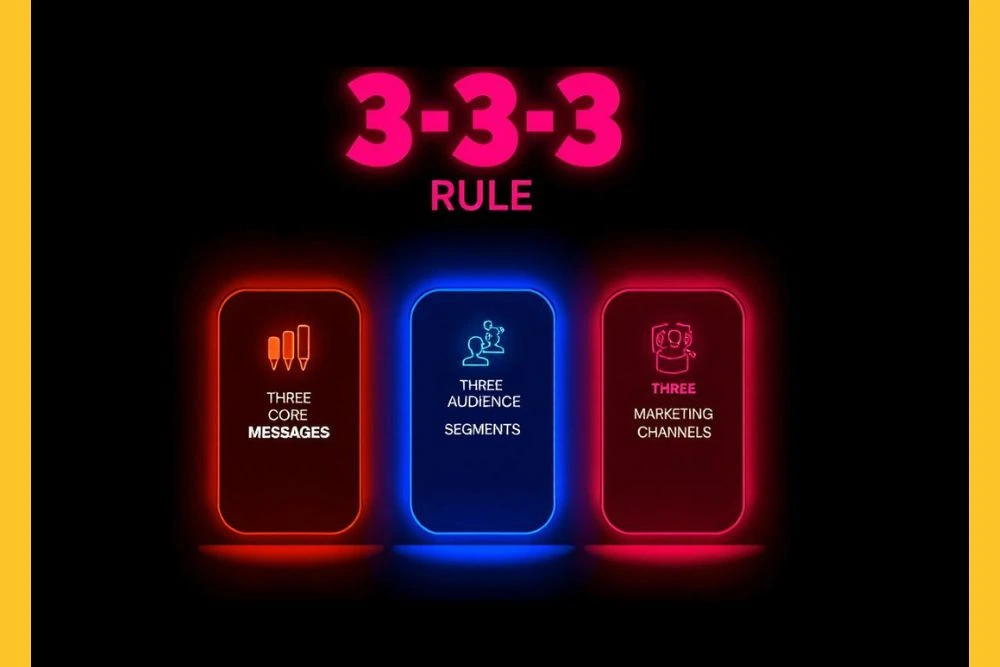
There's a second, related framework that also goes by "the 3-3-3 rule in marketing," and it's worth knowing because you may see it referenced elsewhere. This version applies the same "rule of three" thinking to brand messaging instead of content operations:
Three core messages: the value proposition, identity, and differentiator you want every customer to associate with your brand.
Three audience segments: not everyone is your customer. Picking three priority segments (for example: existing customers, high-value prospects, and one emerging niche) keeps communication targeted instead of generic.
Three marketing channels: the specific platforms where those three audiences are actually active, rather than every channel that exists.
Neither version is "more correct." The messaging version helps you sharpen what you say and to whom. The content-operations version (above) helps you plan what to publish and where. Some teams use both together: the messaging version to set positioning, the content-operations version to plan the actual publishing calendar around it.
Related reading: What Is Psychographic Targeting?
3-3-3 Rule vs. Other Marketing "Rule of Three" Frameworks {#comparison}
The 3-3-3 rule isn't the only simplified framework marketers use. Here's how it stacks up against a few others you'll see referenced:
If you're comparing frameworks for a content calendar specifically, our guide to the 90/10 rule in marketing covers that ratio-based approach in more depth.
Not the Same as the 3-3-3 Rule for Anxiety or Sales {#not-confused}
Because "3-3-3 rule" is a catchy, memorable name, it gets reused outside marketing too. Quick disambiguation so you land on the right framework:
3-3-3 rule for anxiety is a grounding technique (name 3 things you see, 3 sounds you hear, move 3 body parts) used in mental health contexts, unrelated to marketing.
3-3-3 rule in sales sometimes refers to a follow-up cadence (contacting a prospect at 3 days, 3 weeks, and 3 months), which is a sales process concept, not a content or messaging framework.
3-day texting rule is a dating/relationship convention, occasionally confused with "3-3-3" due to similar phrasing.
If you found this page searching for one of those, the marketing version above is a different concept entirely, worth knowing since all three occasionally get lumped together in search results.
How to Implement the 3-3-3 Rule: Step by Step {#how-to}
Audit what you're already publishing. List every piece of content from the last 90 days and tag it by type (educational/inspirational/entertaining), channel (owned/earned/paid), and funnel stage. Most brands find they're overloaded in one bucket and nearly empty in another.
Pick your three content types and commit. You don't need to invent new formats. Assign existing formats (blog posts, testimonials, short-form video, etc.) into the three buckets.
Choose your three channels based on data, not preference. Look at where your existing traffic and engagement actually come from, not where's trendy this quarter.
Map content to funnel stage. For each planned piece, ask: is this for someone who doesn't know us yet, someone comparing options, or someone ready to buy? Write for that specific person.
Build a simple content calendar that rotates through all three content types across all three channels, matched to funnel stage, on a repeatable schedule (weekly or biweekly works for most teams).
Track and adjust monthly. Look at which content type, channel, and funnel stage combination is actually driving results, and shift effort toward what's working. The framework only helps if you're reviewing the data.
Real Brand Examples {#examples}
Apple:
Product Launch Messaging. Apple's major launches consistently centre on a tight set of themes (performance, camera, design) delivered through a narrow set of channels: its own website, YouTube keynote videos, and email to existing customers, a clean example of owned-media-first distribution paired with focused messaging. (Lessons from Apple's 50-Year Run)
Nike:
Content Rotation. Nike mixes emotionally-driven brand films (inspirational), athlete training content (educational), and culture-driven social moments (entertaining), distributed mainly through owned social channels and earned media from athlete partnerships and press coverage.
Duolingo:
Funnel-Matched Content. Duolingo's viral, entertaining social content (its mascot-driven TikToks) drives top-of-funnel awareness at scale, while its in-app onboarding and email sequences handle consideration and decision-stage messaging, a good example of matching content type to funnel stage rather than using one format everywhere.
Common Mistakes That Make the 3-3-3 Rule Fail {#mistakes}
Treating it as a one-time exercise. Picking three content types and three channels once, then never revisiting the choice as your audience or platforms change.
Skipping the funnel-stage mapping. Publishing only awareness-stage content (or only decision-stage offers) means the framework only does half its job.
Choosing channels based on trends instead of data. Being on a channel because a competitor is, rather than because your actual audience is active there.
Ignoring earned media entirely. Many brands default to owned + paid and skip earned media (reviews, PR, word of mouth) even though it's often the most trusted channel by prospects.
Applying both "3-3-3" versions at once without a plan. Trying to run the messaging version and the content-operations version simultaneously without deciding which sets the strategy and which handles execution creates conflicting priorities.
Related reading: How to Build a Brand Awareness Strategy
How Marko & Brando Applies the 3-3-3 Rule {#our-approach}
We use this framework with clients as a planning tool, not a rigid checklist. In practice, that means: auditing existing content against the three-type/three-channel/three-stage grid, identifying the gaps (usually consideration-stage content and earned media are underused), and rebuilding the content calendar around what the audit shows, then reviewing performance monthly and adjusting channel mix as the data comes in.
If you want a marketing partner who applies this kind of structured thinking to your brand's content and distribution strategy, Marko & Brando can help.
FAQs {#faqs}
What is the 3-3-3 rule in marketing?
It's a framework for structuring content around three content types (educational, inspirational, entertaining), three distribution channels (owned, earned, paid media), and three stages of the buyer's journey (awareness, consideration, decision).
Is there more than one version of the 3-3-3 rule?
Yes. Alongside the content/channel/funnel version above, some marketers use a messaging-focused version built around three core messages, three audience segments, and three channels. Both are legitimate; they solve different problems.
What is the 333 rule in marketing?
"333 rule" and "3-3-3 rule" refer to the same framework, just written without hyphens or spacing.
What are the benefits of the 3-3-3 rule in digital marketing?
Clearer content planning, better use of limited time and budget, more consistent publishing, and content that actually matches where your audience is in their decision process, rather than guessing.
Is the 3-3-3 rule good for small businesses and startups?
Yes, arguably more so than for large brands. Small teams especially benefit from limiting scope to three content types and three channels, since it prevents the common startup mistake of trying to be active everywhere at once with no consistency anywhere.
How is the 3-3-3 rule different from the 50/30/20 rule?
The 50/30/20 rule allocates your content mix by percentage (50% engaging, 30% informative, 20% promotional), while the 3-3-3 rule structures content by type, channel, and funnel stage. They can be used together: 50/30/20 for the ratio, 3-3-3 for the structure.
How can Marko & Brando implement the 3-3-3 rule for my brand?
We start with a content and channel audit, identify which of the three pillars is underused, and rebuild your content calendar and distribution plan around the gaps, then track performance monthly to keep it working. Get in touch to start with a free audit.
.webp)
Article by
Deep Mondal
I help businesses turn organic search into a consistent source of qualified leads and revenue, not just traffic. With years of hands-on SEO experience, I specialize in combining AI-driven SEO, technical optimization, and search intent strategy to help brands grow across both traditional search and emerging AI platforms.


Durga Puja Marketing Guide: How Brands Can Win the Pujo Season in Kolkata

Deep Mondal
October 09, 2026

Real Estate Lead Generation Guide: Tools, Tactics & Examples
Marko & Brando
September 24, 2026
Best Financial Services Advertising Strategy for Banks
Marko & Brando
September 20, 2026

What Is a Content Calendar? Examples and a Step-by-Step Guide
Marko & Brando
September 15, 2026